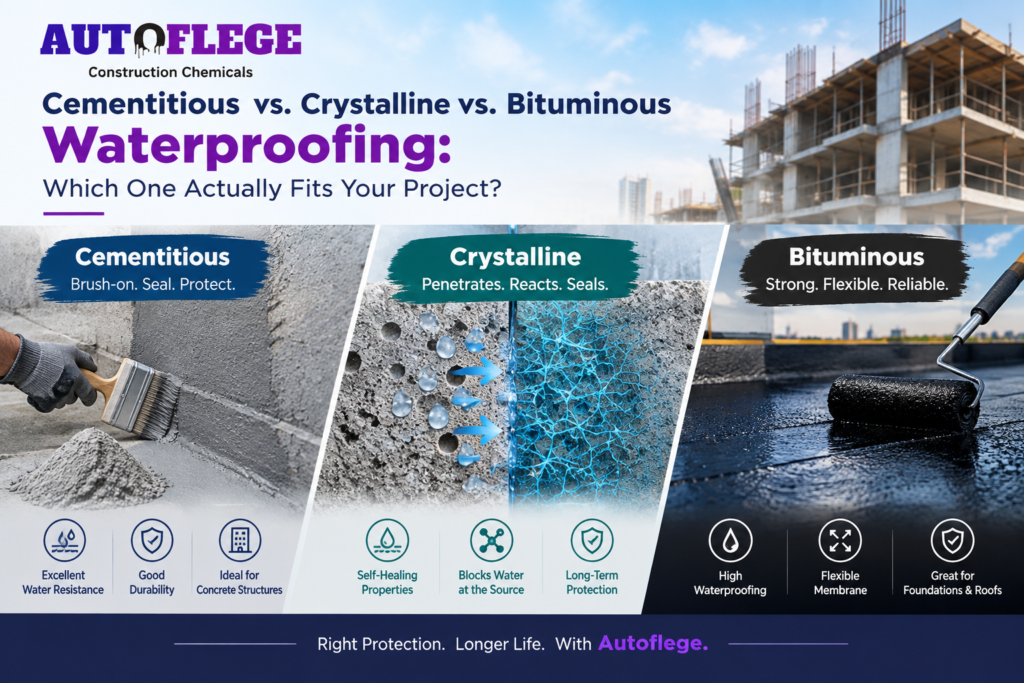
Cementitious vs. Crystalline vs. Bituminous Waterproofing: Which One Actually Fits Your Project
Ask five different contractors which waterproofing system truly gets the job done, and you’ll hear five completely different answers everyone swears by their favourite, and nobody’s backing down. But let’s be real for a second: there isn’t one magic waterproofing compound that’s perfect for every situation. Cementitious, crystalline, and bituminous systems all have their sweet spots, and they mess up in their own unique ways, too. The smart move isn’t just picking “the best,” but really digging into what each area of your project needs what’s the surface, what’s it up against, and what’s going to happen to it after you finish the job. So, let’s cut through the marketing noise and actually break down how these systems measure up.
Cementitious Waterproofing
Most contractors know cementitious coatings inside and out they’re familiar, almost like plastering. You mix a cement-based powder with water or a polymer liquid, then brush or trowel it on. Do a couple coats, and you’re set. These coatings bond well to concrete and masonry, don’t need any fancy tools, and go on easily, which is why everybody turns to them for bathrooms, kitchens, terraces pretty much anywhere in India where tiling follows waterproofing.
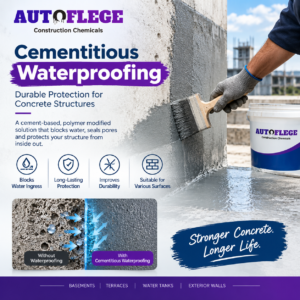
Here’s the thing, though: flexibility is where cementitious falls short. Once it cures, a plain cementitious layer turns rigid. So, if your building shifts even a bit, or hairline cracks crop up from temperature changes or settling after you’re done, those cracks can run right through your fancy coating. Water will find its way in, no matter how careful you were. That’s why you see so many polymer-modified cementitious coatings nowadays by blending cement with acrylic or latex polymers, you get a coating that flexes just enough to span tiny cracks (around 1–2mm, depending on the brand). You don’t lose that trusty bond or the easy application, but it’s way more forgiving in the real world.
So, where does cementitious waterproofing shine? You want it for bathrooms, kitchen wet spots, terraces, balconies, inside water tanks anywhere that’s getting tiled afterward, really. It sticks well under tile adhesives and handles those indoor, covered spots like a champ.
But for big expansion joints, active surfaces that shift, or exposed roof areas that see wild sun and temp swings, standard cementitious isn’t your best bet unless you’ve got a reinforced, specially-formulated version built for the job.
Crystalline Waterproofing
Now, crystalline waterproofing is different from the ground up. Instead of laying a layer on top, this stuff gets inside the concrete. It’s cooked up from Portland cement, fine silica sand, and special chemicals that dig into concrete and react with moisture and free lime hiding in the structure. The reaction creates crystals that grow in all those tiny pores and pathways where water tries to sneak through.
The wild part? This waterproofing becomes part of the concrete itself, not just a separate skin. So as the years go by, if a little hairline crack tries to form, any moisture that seeps in activates leftover chemicals, which keep plugging those new gaps. You don’t need to re-apply anything. That’s exactly why crystalline treatment is the gold standard for underground water tanks, basements, or retaining walls any spot that deals with constant water pressure and is a nightmare to access for repairs.
It also works on the negative side, meaning you don’t have to be on the wet face of a wall huge deal for basements where the outside is buried and unreachable. The catch? Crystalline systems usually cost more for every square metre, and you need solid, porous concrete for it to work no place for it on masonry, plaster, or super-finished surfaces where the material can’t migrate inside.
Crystalline waterproofing is the go-to for secluded spots under hydrostatic water pressure think underground tanks, basements, lift pits, and retaining walls. If you’re working with brick, plaster, or tight budgets (and don’t have a ton of water pressure riding on the choice), you might want to look at something else.
Bituminous Waterproofing
Bituminous options hot or cold-applied bitumen, bituminous paints, or those black self-adhesive membranes rely on bitumen’s natural water-resistance and its ability to flex. Unlike rigid cementitious coatings, bituminous membranes have some give, so they won’t crack when your roof or terrace expands and contracts in the sun and rain. In fact, UV-resistant bituminous membranes are why you see them used so widely on exposed rooftops.
There are a couple ways to go. You’ve got torch-applied or self-adhesive sheet membranes, which you roll out and seal at the overlaps, and you’ve got liquid-applied bituminous coatings you can paint or roll on. Sheet membranes keep the thickness nice and even, but you’ve gotta really nail the details one sloppy overlap and you’ll have leaks. Liquid coatings are great for complicated shapes and corners, but only if you get the thickness of every layer just right.
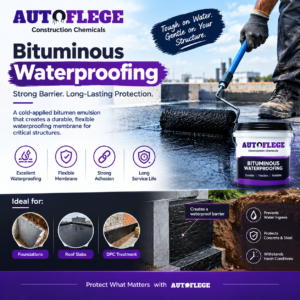
Bituminous waterproofing is a strong pick for exposed rooftops, roof-to-parapet junctions, expansion joints, and for protecting underground structures on the outside before backfilling. But for wet interiors bathrooms or kitchens it’s a poor choice; the smell and high VOCs aren’t exactly welcome indoors, and you can’t tile over it directly without putting something else on top.
So, Which One Do You Actually Need?
No real project uses just one system for everything it’s all about matching each area with what fits. In a typical house, you’ll probably see a polymer-modified cementitious coating in the bathrooms and kitchen, crystalline treatment for the underground tank and basement, and a bituminous membrane or UV-stable elastomeric coating on the rooftop. Making it an “all or nothing” choice almost always backfires I see projects fail not because the product’s bad, but because it gets put somewhere that needs a different property. Like using brittle cementitious stuff on a roof that’s supposed to flex it can’t take it.
Here’s an easy way to keep things straight. If the surface stays wet or handle water pressure, but doesn’t move much, go crystalline. For a tiled wet area like a bathroom or kitchen, polymer-modified cementitious is practical and reliable. For sun-baked or rain-pounded spots that expand and contract, go with bituminous or elastomeric membranes.
If you’re tangled up in the options figuring out what works for your location, your building, your budget don’t just wing it. You’re better off getting someone technical to walk through the details with you, and recommend a system, not just a product. Getting the match right up front saves you way more money and hassle than having to rip everything up and start over because the first round of waterproofing wasn’t actually right for the job.